

Martina Hingis and her new husband Thibault Hutin.
Why does this photo make me laugh?

So which is it people?
Is she or ain’t she?
For those that missed it (report to the headmasters office), Wertheim thinks she is and opened up the latest chapter in the debate no-one-wants-to-admit-to-wanting-to-debate with this little number.
The subsequent response has, by all accounts, been overwhelming – both in it’s support and it’s vitriol.
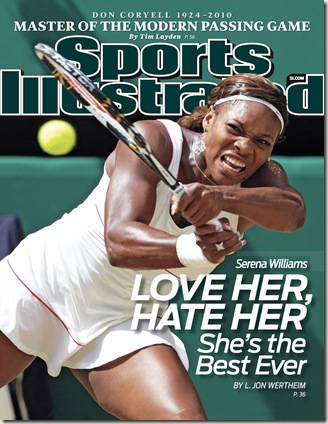
“Hate her”? Never mind.
Tignor was one of those who didn’t agree
Me, I’m on Wertheim’s side.
Whether or not you choose to crown her GOAT, DOE or any other category of thoroughbred livestock, it does now seem reasonable to speak of her in the same breath as the “tennis greats” – what’s more, is you can do this without getting into how many Slams she has or might yet win.
Tignor set out his stall by deconstructing, piece by piece, the central tenets of the pro-Serena lobby (both those coming from Wertheim and his mailbag respondents).
I agreed with most of what he said, just as I agreed with most of what Wertheim had to say – which shows, I suppose, the utter folly of it all.
Not that that’s going to put anyone off any time soon.
Then Steve began talking about H2Hs and intra-era domination and I was back in Camp Wertheim again, this time watching a more self-assured version of myself deconstruct Tignor’s deconstruction.
» “None of the others had to play her sister in a final.”
Not that playing Venus doesn’t represent a unique psychological proposition, but still – why exactly is this relevant?
(Tignor 1, Wertheim 0)
» “She has also won 12 major women’s doubles titles, two major mixed titles, and two double gold medals.”
I accord doubles a unique position in the game and I still don’t think it gets quite the respect it’s due. But do I think it should factor into the Best-Ever debate?
No I don’t.
(Tignor 1, Wertheim 0)
» “She’s been winning them since she was 17.”
As Tignor shows, you can use this to argue anything you want. Just as you can take any other stat and extrapolate from it any conclusion that fits the bill – your particular bill.
(Tignor 2, Wertheim 1)
» “The most important stroke in tennis is the serve, and Williams’s is the most fearsome in women’s history.”
No question about that, and certainly talk of how the serve makes the job of dominating that much easier might reasonably add fodder to the debate - in the same way that popcorn sometimes does.
By the same token, however, and as Tignor shows, “greatness” is about more than any individual stroke, however devastating.
And popcorn is sometimes just popcorn – a fluffy, insubstantial, low calorie food substitute.
(Tignor 3, Wertheim 1)
» “If you matched tennis’s female legends head-to-head—all at their best, with identical equipment—Williams wouldn’t just beat the others; she’d crush them.”
This is the argument that carries most weight with me. Dunno about “crush”, though distil it further and this amounts to simply saying that Serena is better than anyone and everyone else.

That, all things being equal, on a level playing field, adjusting for inter-era disparities of age, physique, technology & nail-filing abilities, playing under a moonless sky with wooden racquets on hallowed turf within the hedgerows of that halfway house that lies somewhere in between the yellow-brick road and the end of the rainbow, with Mohd Lahyani officiating and with a diet of moonshine and “Frankie Lymon and the Teenagers” served up during the changeovers, Serena comes out on top nine times out of ten.
I love this hypothetical “ground-zero” setup. I love it for it’s simplicity. I also love it for the fact that it’s a complete nonsense.
But most of all, I love it for the way it cuts both neatly and indiscriminately through those needless swaths of statistics and subjectivity – for the way it applies Occam’s Razor to the GOATs beard and ends up shaving it clean off.
(Tignor 3, Wertheim 2)
Allowing us, mere mortals,to abtract ourselves away from all that shite about H2Hs and Calendar Grand Slams to focus on what should matter: how all these greats stack up against one another, viewed in a purely transcendent qualitative light.
And here’s the part of the rebuttal I have a problem with:
Serena would crush Court and Evert, I agree, and beat Graf and Navratilova most of the time. But I would also say that the 500th-ranked man on the ATP tour right now would beat Don Budge—at his best, with identical equipment—like a drum. Does that make No. 500 from 2010 a greater player and champion than Budge, or Tilden, or Gonzalez?
Saying the 500th ranked male could beat Budge or, indeed, Laver in his prime is not so much an argument against Serena being GOAT as it is against anyone being GOAT.
In any case, it’s yet another variation on the folly of inter-era comparisons.
Though if GOAThood is such a flawed concept (and it is), you can’t argue Serena isn’t GOAT anymore than you can that she is.
(Tignor 3, Wertheim 3)

Ditto, saying that you can’t penalise players for being born in years gone by.
Every player, obviously, is a product of his or her era. The best player of any era has trained and designed her game to beat the opponents she has to face on the court—nothing more, nothing less. You can’t penalize Graf and Navratilova for not making themselves good enough in their primes to beat a hypothetical future opponent.
If Serena had made her debut, say, three years after Graf’s debut, and Serena had started taking Slams from her, Steffi would have been forced to change her game to meet this challenge. We’ll never know how that would worked out, so all we can do to compare them is to look at their overall records during the times when they were playing.
An admirable but ultimately flawed sentiment.
People will always talk of GOATS for the same reason people will always buy talk of GOATs. And when they do, it seems to me that they’ll prune whomsoever they want from the debate – mostly, it has to be said, players from years gone by.
You can argue against doing that, but it’s the same logic that sees us prune the Pre-Open Era in it’s entirety, and I don’t see half so many people arguing against that.
(Tignor 3, Wertheim 4)
Despite that, Tignor’s point about unfair penalisation does sound reasonable. It’s not Steffi’s fault, after all, that she turned pro in 1982 (at the age of 13…ulp) anymore than it’s Suzanne Lenglen’s fault that she was born in 1899.
(Tignor 4, Wertheim 4)
Though it’s worth remembering that the converse hold true too: It’s not Serena’s fault that she turned pro in 1995 and thereby unwittingly made herself unavailable for foolproof comparisons with Billie Jean King.
Furthermore, consider for a moment what precisely it means to never be able to penalise anyone for being born in a previous era.
Every time you pronounce Federer, Serena, Sampras, Steffi or, for that matter, BJK or Margaret Court, “the GOAT”, you are at once, in a single sweep and in no more than six syllables, penalising everyone that came before them.
Obeying the “no penalisation” rule completely and without compromise, precludes us from ever discussing GOATs, their sub species and any further genetically-cloned derivations thereof.
Which is fine, say, if you’re calling for their abolition - it’s a deeply flawed, deeply populist idea, after all, that deserves to be shown for what it is.
You’d also be well within your rights to preface anything you might want to say with the standard “I don’t do GOATs, but….” disclaimer.

Once you accept the plausibility of the debate (if not the integrity of it) and dive in, however, it’s utter folly to shy away from wanting to penalise anyone.
(Tignor 4, Wertheim 5)
And as with the Federer-Nadal head-to-head argument, the fact that someone can beat another player doesn't make them "greater"—top players play to win tournaments, not beat certain individuals.
The same will be true when a young serve-and-volleying Russian starts racking up Slams 15 years from now. We won’t be able to look back and penalize Serena for not having made her game consistent or versatile enough to have beaten her.
In other words, H2Hs should neither determine nor detract from claims to greatness.
I agree.
I would go a step further: it’s less important what your individual head-to-head against your greatest rival or the world #2 or, indeed, any other player is, than is the question of your head to head against the rest of the field.
The latter is a true measure of domination, the former just popcorn.
In any case, head to heads only ever feed into the GOAT debate – they don’t define who or what GOATs are. If we must question Federer’s GOAThood, it shouldn’t be because of his less polished record against Nadal.
» “Williams plays in a far more competitive and demanding era.”
You can argue for or, as Tignor does, against this. More interesting, however, are his thoughts on dominance. Intra-era dominance:
The more important point, though, is that the perceived level of competition in every era is skewed by the level of dominance of the top player. If Graf had never existed, Gabriela Sabatini would likely have been a five-six-seven-time Slam winner rather than a one-timer. If Court had never existed, we’d be talking about Billie Jean King as the best of all time. And while Serena has been the best player of the last decade and of her era, she hasn’t dominated the best player not named Williams, Justine Henin. Serena is 8-6 overall against Henin, but 2-4 at the majors.
If Serena’s claim to greatness is diminished because she hasn’t dominated Henin, then so is Federer’s. Except that’s all rather at odds with what was being suggested before, that individual head to heads “neither determine nor detract from greatness” – it seems they do at least factor into the question of why you’re not the greatest.
(Tignor 4, Wertheim 6)
I haven’t got a beef with Steve (even though I agree with Wertheim). My point here is to illustrate that anyone engaged in “best-ever” pub talk will inevitably, at some point, run into another version of themselves arguing the exact opposite of what they thought they believed in – and their equally well-versed counterpart will be armed with equally well-reasoned arguments that they’ll be equally willing to bash you over the head with. Leading to a series of equally well-rounded welts.
The bottom line is that in each era, the women we’ve mentioned took on the best competition in the world at that moment and raised themselves above it. That’s all you can ask.
Well if that’s all we can ask, then we’re really shafted. And we probably shouldn’t ever talk about GOATs
More seriously though, it seems as though we’re stuck debating the best-ever question whether we like it or not, it piques the romantic sensibility of the populace like nothing else. Wertheim and Tignor don’t seem to mind either.
It would appear instructive, however, to do so in purely transcendent qualitative terms, without getting bogged down with all that statistical baggage about H2Hs and Slam-counts, which, as we’ve seen, can be used to prove that the moon is made of mushy-peas. Or, indeed, that it isn’t.
Which seems to me to be what Jon Wertheim was hinting at:
But I think it counts for a lot that no one has ever played tennis at a higher level than Serena has. (It's the same reason, incidentally, that I was early to pronounce Federer the male GOAT. You just know watching him that no one has played better tennis qualitatively and surely that has to count for something.)
The clincher. You just know. When you’re in the presence of greatness. Don’t you?
After all, I can say without any reservation whatsoever that I don’t believe Chris Evert is the best ever. No slight intended, though feel free to hurl Mississippi Mud Pies at me.

I’m less sure about Navratilova. And when it comes to Serena and Steffi, I’m almost certain I’m in the presence of, if not the very-best, a darn good approximation of whatever my intangible, unspeakably subjective notion of the “greatest” might be.
(Tignor 4, Wertheim 7)
It’s not foolproof. It’s not meant to be. But then neither is talk of Slam-counts, domination, and H2Hs, all of which still feed into the debate – but no longer own it.
The one rebuttal that does carry some weight turns out, funnily (or un-funnily) enough, to be the “weak era theory”.
Serena dominated at a time when Henin, Masha and, to a lesser extent, Davenport were her greatest competition.
Contrast that with Steffi who dominated the way she did in a field comprised of Navratilova, Seles, Hingis and, again, to a lesser extent, Davenport. Not to mention the “lesser champions”, a category that includes Sanchez-Vicario and Sabatini, making up IMO, a better overall field.
(Tignor 5, Wertheim 7)
Even that, however, doesn’t preclude us from pronouncing Serena or, for that matter, Steffi a better player than Navratilova or Evert or Court or Lenglen…that’s the unabashed qualitative beauty of it.
If, based on the evidence supplied, you still want to say Serena is the best of her time (as Tignor headlines his piece) and leave it at that, then that’s fine.
Though you can’t have it both ways and should probably stand on the “Greatest-of-their-time” side of the fence rather than the “Greatest-of-all-time” side of it whenever the question comes up.
Including when it comes up in relation to Federer.
(Final Score: Tignor 5, Wertheim 7)

"No, no, no, sure," the 29-year-old Swiss told French sports daily L'Equipe when asked whether she planned another comeback.
"You can't just snap your fingers and say 'let's go and play the Australian Open'".
…
"I've got a nice house, my four horses," Hingis said. "On the tour, I had no life."
Hingis added that even without being tested positive, she likely would have retired.
"If I had won the four Grand Slam tournaments, maybe I would have continued," she said. "But I was on a downslope. And I was suspended for two years, and that was it."
Hingis, who spent 209 weeks at No. 1 in the women's rankings and won five Grand Slam singles titles, said she went through hard times during her suspension.
"I didn't have the right to play any competition, even in another Olympic sport," she said. "I didn't have the right to feature in equestrian competition, even at an amateur level ... I'm not sure I have completely recovered."
-- Martina Hingis rules out a Pre-Safinite led Comeback
You should never say never, and with the summer of comebacks we’ve just experienced, I probably “never” will again.
But did anyone really expect one from Hingis?
After the way in which the ITF comprehensively put paid to the remainder of her career, and the ‘boys will be boys’ treatment afforded to Gasquet, you can understand her bitterness.
She paints a bleak picture of her form over 2007. A little overly-bleak if you ask me.
It’s worth remembering she finished 2006 ranked #7 in the world. She was beset with injuries the following year, and lost some matches you’d normally have expected her to have won, but also picked up a title in Tokyo taking out Ana Ivanovic in the final, who from what I remember was taking the WTA by storm, and just three months away from her first Slam final.
With the tour in 2008, let’s say, lacking the ‘soul’ of previous years, I just wonder what might have been had she only received a cursory ban (months rather than years); might she, for example, have found it easier to bounce back and re-establish herself in the top ten in the absence of Sharapova and Henin?
That said, there’s something distinctly unsettling in watching a former great being unwilling to retire gracefully. Deciding to play in Melbourne isn’t something you do at the drop of a hat, and Martina certainly doesn’t strike me as the type to risk being exposed to the sort of ridicule a poor showing there would entail.
Interestingly though, it is only the Aussie Open that she’s strictly ruled out. Or so it would appear.
I’d like to know the odds of a Henin-like ‘personal journey’ over the next year.
No, seriously.
Never Say Never Again.
After the first public votes had been cast, the phone votes were added to the judges' scores and the two pairs with the lowest score – Hingis and her partner Matthew Cutler, and Crimewatch presenter Rav Wilding and his partner Aliona Vilani - had to dance their rumba again to try to save themselves.
The judge’s casting vote eventually went against the 'Swiss Miss' of tennis, who admitted afterwards that she may need more dancing lessons.
"It was a great experience, I learned so much,” Hingis said after leaving the BBC1 show. “I wish it would continue but here we are. Maybe I will come back for a few more lessons to London."
...Hingis, 29, was banned for two years by the International Tennis Federation in 2008 after testing positive for cocaine during the 2007 Wimbledon tournament.
Hingis, who declared she was innocent of the drug allegations, last month said she hoped to put the controversy behind her and saw competing on Strictly as a “new challenge”.
“I want people to see a different side to me than the person running round the tennis court,” she said after being announced as one of the celebrity contestants and vowing to win the series.(The Times)
